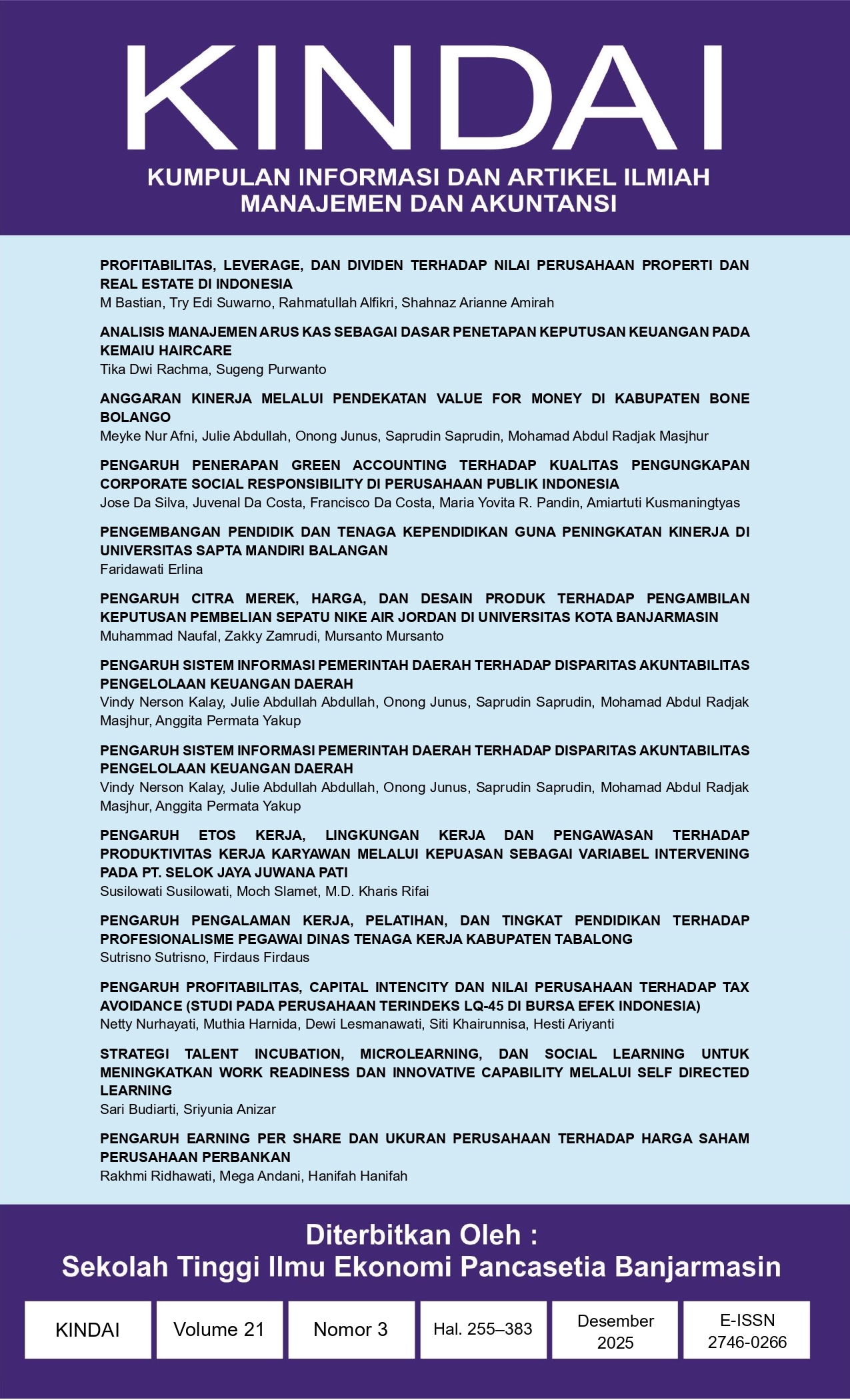
STRATEGI TALENT INCUBATION, MICROLEARNING, DAN SOCIAL LEARNING UNTUK MENINGKATKAN WORK READINESS DAN INNOVATIVE CAPABILITY MELALUI SELF DIRECTED LEARNING
Bilah Samping Artikel
Isi Artikel Utama
Abstrak
Penelitian ini bertujuan menganalisis pengaruh Talent Incubation Strategy, Microlearning Experience, dan Social Learning Support terhadap Work Readiness dan Innovative Capability mahasiswa dengan Self-Directed Learning (SDL) sebagai variabel mediasi. Penelitian menggunakan pendekatan kuantitatif dengan desain survei eksplanatori dan teknik purposive sampling. Analisis data dilakukan menggunakan Partial Least Squares–Structural Equation Modeling (PLS-SEM). Hasil penelitian menunjukkan bahwa Social Learning Support dan Microlearning Experience berpengaruh signifikan terhadap SDL, sementara Talent Incubation Strategy menunjukkan pengaruh yang relatif lemah. Selanjutnya, SDL berpengaruh kuat terhadap Work Readiness dan Innovative Capability. Nilai R² menunjukkan bahwa 55,7% variasi SDL, 41,1% Work Readiness, dan 80,4% Innovative Capability dapat dijelaskan oleh model. Temuan ini menegaskan peran strategis SDL sebagai mediator utama dalam pengembangan kesiapan kerja dan kapabilitas inovatif mahasiswa di era pembelajaran digital.
Kata kunci: talent incubation, microlearning, social learning, self directed learning, work readiness, innovative capability
Unduhan
Rincian Artikel

Artikel ini berlisensi Creative Commons Attribution 4.0 International License.
Referensi
Aboobaker, N., & Zakkariya, K. A. (2021). Digital learning orientation and innovative behavior in the higher education sector: effects of organizational learning culture and readiness for change. International Journal of Educational Management, 35(5), 1030–1047. https://doi.org/10.1108/IJEM-09-2019-0345
Balasundaram, S., Mathew, J., & Nair, S. (2024). Microlearning and learning performance in higher education: A post-test control group study. Journal of Learning for Development, 11(1), 1-14. https://doi.org/10.56059/jl4d.v11i1.752
Bandura, A. (1986). Social foundations of thought and action: A social cognitive theory. Prentice Hall.
Buchem, I., & Hamelmann, H. (2010). Microlearning : A strategy for ongoing professional development. eLearning Papers, 21, 1–15.
Budiarti, S., & Tim Penulis. (2024b). Sistem informasi sumber daya manusia. CV Intelektual Manifes Media. https://www.infesmedia.co.id/buku/detail/192
Budiarti, S., & Tim Penulis. (2024c). Inovasi teknologi dan pemasaran. CV Intelektual Manifes Media. https://infesmedia.co.id/buku/detail/167
Budiarti, S., & Tim Penulis. (2024d). Komunikasi dan negosiasi bisnis. CV Intelektual Manifes Media. https://www.infesmedia.co.id/buku/detail/183
Budiarti, S., & Tim Penulis. (2024e). Pengantar manajemen: Pendekatan dan praktik kontemporer. Eureka Media Aksara. https://penerbiteureka.com/2024/11/22/pengantar-manajemen-pendekatan-dan-praktik-kontemporer/
Budiarti, S., & Tim Penulis. (2024f). Manajemen: Pengantar praktis. CV Intelektual Manifes Media. https://www.infesmedia.co.id/buku/detail/195
Budiarti, S. (2025). The Influence of Digital Learning Capability and Professional Development Support on Lecturer Talent Performance with Self-Efficacy as a Mediator. Jurnal Ekonomi Dan Bisnis Indonesia, 10(1), 31–38. https://doi.org/10.37673/jebi.v10i1.6068
Budiarti, S., & Morita, E. (2023). Teknologi Fintech sebagai Agen Transformasi. Technomedia Journal, 8(3), 126–147. https://doi.org/10.33050/tmj.v8i3.2181
Budiarti, S., et al. (2025). Determinants of creative performance among millennial generation. Corporate & Business Strategy Review, 6(1), 19–32. https://doi.org/10.22495/cbsrv6i1art2
Caballero, C. L., & Walker, A. (2010). Work Readiness in graduate recruitment and selection: A review of current assessment methods. Journal of Teaching and Learning for Graduate Employability, 1(1), 13–25. https://doi.org/10.21153/jtlge2010vol1no1art546
Caballero, C. L., & Walker, A. (2020). Work Readiness in graduate recruitment and selection: A review of current assessment practices. Journal of Education and Work, 33(1), 1–15. https://doi.org/10.1080/13639080.2019.1703304
Carmeli, A., Gelbard, R., & Reiter-Palmon, R. (2013). Leadership, creative problem-solving capacity, and creative performance: The importance of knowledge sharing. Human Resource Management, 52(1), 95–121. https://doi.org/10.1002/hrm.21514
Collings, D. G., & Mellahi, K. (2009). Strategic talent management: A review and research agenda. Human Resource Management Review, 19(4), 304–313. https://doi.org/10.1016/j.hrmr.2009.04.001
Chin, W. W. (1998). The partial least squares approach to structural equation modeling. In G. A. Marcoulides (Ed.), Modern methods for business research (pp. 295–336). Lawrence Erlbaum Associates.
Creswell, J. W. (2014). Research design: Qualitative, quantitative, and mixed methods approaches (4th ed.). SAGE Publications.
Creswell, J. W., & Creswell, J. D. (2018). Research design: Qualitative, quantitative, and mixed methods approaches (5th ed.). SAGE Publications.
de Gagne, J. C., Park, H. K., Hall, K., Woodward, A., Yamane, S., & Kim, S. S. (2019). Microlearning in health professions education: Scoping review. JMIR Medical Education, 5(2), e13997. https://doi.org/10.2196/13997
Eskiyurt, R., & Ozkan, B. (2024). Exploring the impact of collaborative learning on the development of critical thinking and clinical decision-making skills in higher education. Heliyon, 10, e37198. https://doi.org/10.1016/j.heliyon.2024.e37198
Fugate, M., Kinicki, A. J., & Ashforth, B. E. (2004). Employability: A psycho-social construct, its dimensions, and applications. Journal of Vocational Behavior, 65(1), 14–38. https://doi.org/10.1016/j.jvb.2003.10.005
Garavan, T. N., Carbery, R., & Rock, A. (2012). Mapping talent development: Definition, scope and architecture. European Journal of Training and Development, 36(1), 5–24. https://doi.org/10.1108/03090591211192601
Garrison, D. R. (2020). E-learning in the 21st century: A community of inquiry framework for research and practice (3rd ed.). Routledge. https://doi.org/10.4324/9780429029160
Gana, K., & Broc, G. (2019). Structural equation modeling with lavaan. Routledge. https://doi.org/10.4324/9781315222464
Ghozali, I., & Latan, H. (2021). Partial least squares: Konsep, teknik dan aplikasi menggunakan SmartPLS 3.0. Badan Penerbit UNDIP.
Hair, J. F., Hult, G. T. M., Ringle, C. M., & Sarstedt, M. (2021). A primer on partial least squares structural equation modeling (PLS-SEM) (3rd ed.). SAGE Publications.
Hair, J. F., Hult, G. T. M., Ringle, C. M., & Sarstedt, M. (2021). A Primer on Partial Least Squares Structural Equation Modeling (PLS-SEM) (3rd ed.). SAGE Publications.
Sarstedt, M., Ringle, C. M., & Hair, J. F. (2022). Partial least squares structural equation modeling. In Handbook of Market Research. Springer.
Henseler, J., Ringle, C. M., & Sarstedt, M. (2021). Testing measurement invariance of composites using partial least squares. International Marketing Review, 38(3), 552–570. https://doi.org/10.1108/IMR-05-2020-0126
Hug, T. (2005). Microlearning and narration: Exploring possibilities of utilization of narrations and storytelling for the designing of “micro units” and didactical micro-learning arrangements. In Proceedings of the Media in Transition Conference. MIT.
Ilham, M., & Sari, D. D. (2025). Microlearning in Higher Education: Student Challenges and Engagement. Asghar: Journal of Children Studies, 5(1), 69-77. https://doi.org/10.28918/asghar.v5i1.10476
Jackson, D. (2015). Employability skill development in work-integrated learning: Barriers and best practice. Studies in Higher Education, 40(2), 350–367. https://doi.org/10.1080/03075079.2013.842221
Jackson, D. (2016). Re-conceptualising graduate employability: The importance of pre-professional identity. Higher Education Research & Development, 35(5), 925–939. https://doi.org/10.1080/07294360.2016.1139551
Judijanto, L., & Widyatmoko. (2024). The impact of business incubation programmes on start-up success and economic growth in Indonesia. West Science Journal Economic and Entrepreneurship, 2(04), 517–524. https://doi.org/10.58812/wsjee.v2i04.1406
Kulkarni, P., Tigadi, B., Gokhale, P., & K., L. (2024). University incubators performance through the lens of institutional theory. Vilakshan XIMB Journal of Management. https://doi.org/10.1108/XJM-02-2024-0029
Knowles, M. S., Holton, E. F., & Swanson, R. A. (2015). The adult learner: The definitive classic in adult education and human resource development (8th ed.). Routledge.
Laily, N., et al. (2024). Manajemen Sumber Daya Manusia: Transformasi dan Inovasi di Era Digital. Eureka Media Aksara. https://repository.penerbiteureka.com/publications/588437
Lave, J., & Wenger, E. (1991). Situated learning: Legitimate peripheral participation. Cambridge University Press. https://doi.org/10.1017/CBO9780511815355
Martins, L. V., et al. (2024). Pengantar metodologi penelitian: Strategi dan teknik. Infes Media. https://www.infesmedia.co.id/buku/detail/181
Microlearning beyond boundaries. (2024). Microlearning beyond boundaries: A systematic review and a novel framework. Heliyon, 10, e17444. https://doi.org/10.1016/j.heliyon.2024.e17444
Morris, T. H. (2019). Self Directed Learning: A fundamental competence in a rapidly changing world. International Review of Education, 65(4), 633–653. https://doi.org/10.1007/s11159-019-09793-2
Nandini, W. (2023). A Social Learning Theory Perspective: The Mechanism of Work Engagement, Active Learning and Individual Adaptive Performance in Creative Industries (Doctoral dissertation, Institut Teknologi Bandung). Digilib ITB. Retrieved from https://digilib.itb.ac.id/assets/files/2023/MjAyMyBEUyBQUCBXaWR5YSBOYW5kaW5pICAgWzM5MDE5MDA2XSAtIEZ1bGwgVGV4dC5wZGY.pdf
Ramayah, T., Cheah, J., Chuah, F., Ting, H., & Memon, M. A. (2021). Partial Least Squares Structural Equation Modeling (PLS-SEM) using SmartPLS 3.0: An updated and practical guide to statistical analysis (2nd ed.). Pearson.
Sarstedt, M., Ringle, C. M., & Hair, J. F. (2022). PLS-SEM: Looking back and moving forward. Long Range Planning, 55(5), 102–116. https://doi.org/10.1016/j.lrp.2021.102140
Sekaran, U., & Bougie, R. (2020). Research methods for business: A skill-building approach (8th ed.). Wiley.
Siswanto, S. (2024). The effect of Self Directed Learning (SDL) in higher education: Increasing student independence and achievement. Jurnal Inovasi Teknologi Pendidikan, 11(1), 35–43. https://doi.org/10.21831/jitp.v11i1.60338
Sugiyono. (2021). Metode penelitian kuantitatif, kualitatif dan R&D. Alfabeta.
Soegijapranata, C. T. M., Hartono, H., & Nugroho, A. C. (2022). Self Directed Learning, self-efficacy, and technology readiness in e-learning among university students. KnE Social Sciences, 7(14), 213–224. https://doi.org/10.18502/kss.v7i14.11970
Teece, D. J., Pisano, G., & Shuen, A. (1997). Dynamic capabilities and strategic management. Strategic Management Journal, 18(7), 509–533. https://doi.org/10.1002/(SICI)1097-0266(199708)18:7
Teece, D. J. (2020). Strategies for innovation and dynamic capabilities. Long Range Planning, 53(1), 101910. https://doi.org/10.1016/j.lrp.2019.101910
Tynjala, P. (2013). Toward a 3-P model of workplace learning: A literature review. Vocations and Learning, 6(1), 11–36. https://doi.org/10.1007/s12186-012-9091-z
Yang, Y., Zhang, Y., & Chen, L. (2025). Understanding university students’ self-directed online learning: The role of digital literacy and learning readiness. Journal of Computing in Higher Education. https://doi.org/10.1007/s12528-025-09458-0